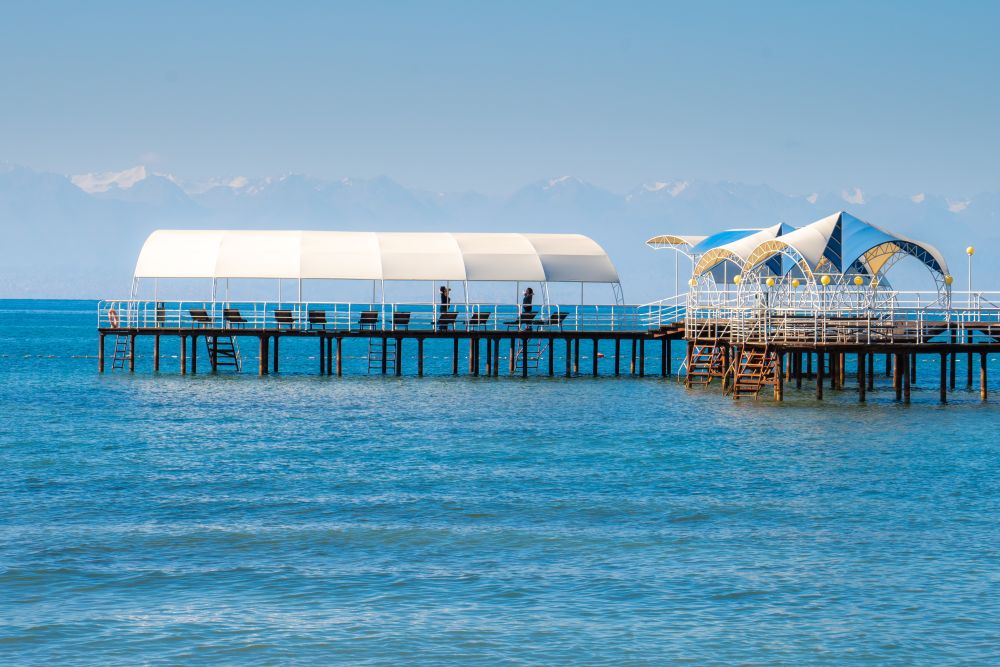
Issyk-Kul is the largest lake in Kyrgyzstan and one of the largest alpine lakes in the world. Located at an elevation of 1,607 meters above sea level between the Kungey Ala-Too and Terskey Ala-Too mountain ranges, the lake covers more than 6,200 square kilometers and is considered one of the most famous natural attractions in Central Asia.
Issyk-Kul is often called the “Eye of the Earth” because of its distinct almond-shaped form and the snow-covered mountain ranges that resemble eyelashes when viewed from space.
The lake attracts visitors with its combination of warm climate, crystal-clear water, sandy beaches, and spectacular mountain scenery. Here, travelers can combine beach holidays, sightseeing, outdoor adventures, and cultural experiences connected to the traditions of the Kyrgyz people.
Issyk-Kul is suitable for families with children, nature lovers, photographers, adventure travelers, and anyone interested in discovering nomadic culture.
The best time to visit is from June to September.
History and Legends of Issyk-Kul
How the Lake Was Formed
Millions of years ago, tectonic movements within the Tian Shan Mountains created a vast depression that later filled with water, forming the azure heart of Kyrgyzstan known today as Issyk-Kul Lake.
Although nearly 80 rivers flow into the lake and none flow out, its enormous depth of up to 668 meters and constant water circulation keep the water exceptionally clear.
From space, this endorheic lake surrounded by snow-covered mountain ranges resembles a living human eye that has witnessed the rise and fall of civilizations for centuries.
This comparison is more than poetic. Archaeologists continue to discover submerged settlements of the ancient Silk Road and Scythian burial sites beneath the lake, turning Issyk-Kul into one of Central Asia’s greatest archaeological mysteries.
The Legend of Issyk-Kul
Among the many legends explaining the origin of the lake, one remains the most famous.
Long ago, a powerful sorcerer-khan fell in love with a beautiful young woman named Issyk-Kul. Captivated by her beauty, he demanded that she become his wife. However, her heart already belonged to the mighty warrior Tian Shan.
When Tian Shan tried to protect his beloved, the furious sorcerer used dark magic and turned him into stone. Even then, Issyk-Kul refused to submit to the khan’s will.
Enraged, the sorcerer cursed her, declaring that if she could not belong to him, she would belong to no one. He transformed her into pure water.
Yet love proved stronger than the curse. The petrified giant Tian Shan gathered his remaining strength and embraced his beloved before she disappeared beneath the earth.
His right arm became the Terskey Ala-Too Range, and his left arm became the Kungey Ala-Too Range. Their children transformed into countless rivers and streams that continue to flow from the mountains into the lake, forever remaining close to their mother.
Where is Issyk-Kul Located?
Issyk-Kul is located in northeastern Kyrgyzstan, approximately 250 kilometers from Bishkek.
The lake has two very different coastlines:
Northern Shore
The northern shore is the center of resort life, featuring developed infrastructure, sandy beaches, hotels, and entertainment facilities.
Popular destinations include Cholpon-Ata, Bosteri, Kara-Oy, and Tamchy.
Southern Shore
The southern shore is quieter and more authentic, attracting travelers looking for nature, adventure, mountain gorges, and traditional yurt camps.
This part of the lake offers fewer tourists but significantly more untouched landscapes and cultural experiences.
How to Get to Issyk-Kul from Bishkek
By Car
A modern paved highway connects Bishkek with Issyk-Kul through Boom Gorge.
The drive usually takes between 3 and 4 hours depending on the destination.
By Minibus
Daily minibuses and buses depart from Bishkek Bus Station to Cholpon-Ata, Bosteri, Bokonbaevo, and other settlements along the lake.
As Part of a Tour
Joining a guided tour is one of the most convenient options, allowing visitors to explore the region with experienced guides and without planning logistics independently.
What to See at Issyk-Kul
Mountain Gorges
Issyk-Kul is surrounded by some of the most beautiful mountain valleys in Kyrgyzstan.
Visitors can explore Grigoriev Gorge and Semenov Gorge on the northern shore, the famous Jeti-Oguz Gorge with its Seven Bulls red rock formations, the spectacular Barskoon Gorge with its waterfalls, and the thermal paradise of Altyn Arashan near Karakol.
Spectacular Canyons
The southern shore is famous for its dramatic canyon landscapes.
Fairy Tale Canyon amazes visitors with colorful sandstone formations resembling castles and mythical creatures. Kok-Moinok Canyon features narrow labyrinth-like passages, while Ak-Sai Canyon offers breathtaking views over ancient dry riverbeds and the blue waters of Issyk-Kul.
Konorchek Canyon, located on the route from Bishkek, impresses visitors with landscapes often compared to the Grand Canyon of the United States.
Hot Springs
Issyk-Kul’s thermal springs, rich in minerals and radon, attract visitors throughout the year.
Many hot spring resorts allow travelers to relax in warm outdoor pools while enjoying views of the snow-covered Tian Shan Mountains.
Unique Museums
The region offers numerous cultural attractions and museums.
Highlights include the Open-Air Petroglyph Museum in Cholpon-Ata, featuring ancient rock carvings, the Rukh Ordo Cultural Center dedicated to interfaith harmony, the Przhevalsky Memorial Complex near Karakol, the unique Dungan Mosque built without nails, and the mysterious abandoned Aalam Ordo cultural complex on the southern shore.
National Cuisine of Issyk-Kul
Issyk-Kul offers a rich mix of culinary traditions shaped by Kyrgyz, Dungan, and Uyghur cultures.
In Cholpon-Ata, visitors can enjoy traditional Kyrgyz dishes such as lagman and beshbarmak in local restaurants like “Barashek”, known for hearty portions and authentic flavors.
In Karakol, travelers should try the famous spicy Ashlan-Fu, a signature cold noodle dish introduced by the Dungan community. One of the best places to experience it is the traditional “Dastorkon” ethnic restaurant.
In the Ton region, visitors can experience nomadic cuisine prepared over an open fire inside authentic yurts right on the lakeshore, offering a true taste of Kyrgyz pastoral life.
When to Visit Issyk-Kul
Spring
Ideal for sightseeing and light travel. Mountains are covered with greenery and wildflowers.
Summer
Peak tourist season. Air temperatures reach +25…+35°C, and the lake becomes warm enough for swimming.
Autumn
A perfect time for a peaceful vacation and photography, with fewer tourists and pleasant weather.
Winter
Popular for skiing, snowboarding, and hot spring experiences around the lake.
Useful Travel Tips
- Use sunscreen even on cloudy days.
- Bring warm clothing for evenings.
- Wear comfortable shoes for mountain excursions.
- Carry cash in Kyrgyz soms for small villages.
- Visit popular attractions early in the morning to avoid crowds.
Frequently Asked Questions
Can you travel to Issyk-Kul with children?
Yes. The northern shore is especially suitable for families thanks to its infrastructure and safe beaches. The southern shore is better for light nature trips and cultural experiences.
How many days do you need for Issyk-Kul?
A minimum of 3–5 days is recommended to explore key attractions.
Can you swim in Issyk-Kul?
Yes. The swimming season typically lasts from June to September.
Tours to Issyk-Kul
We organize private and group tours to Issyk-Kul with comfortable transport, accommodation, guided excursions, and professional local guides.
Our itineraries help travelers discover the most beautiful landscapes of Kyrgyzstan, including mountain gorges, canyons, hot springs, cultural landmarks, and authentic nomadic traditions.