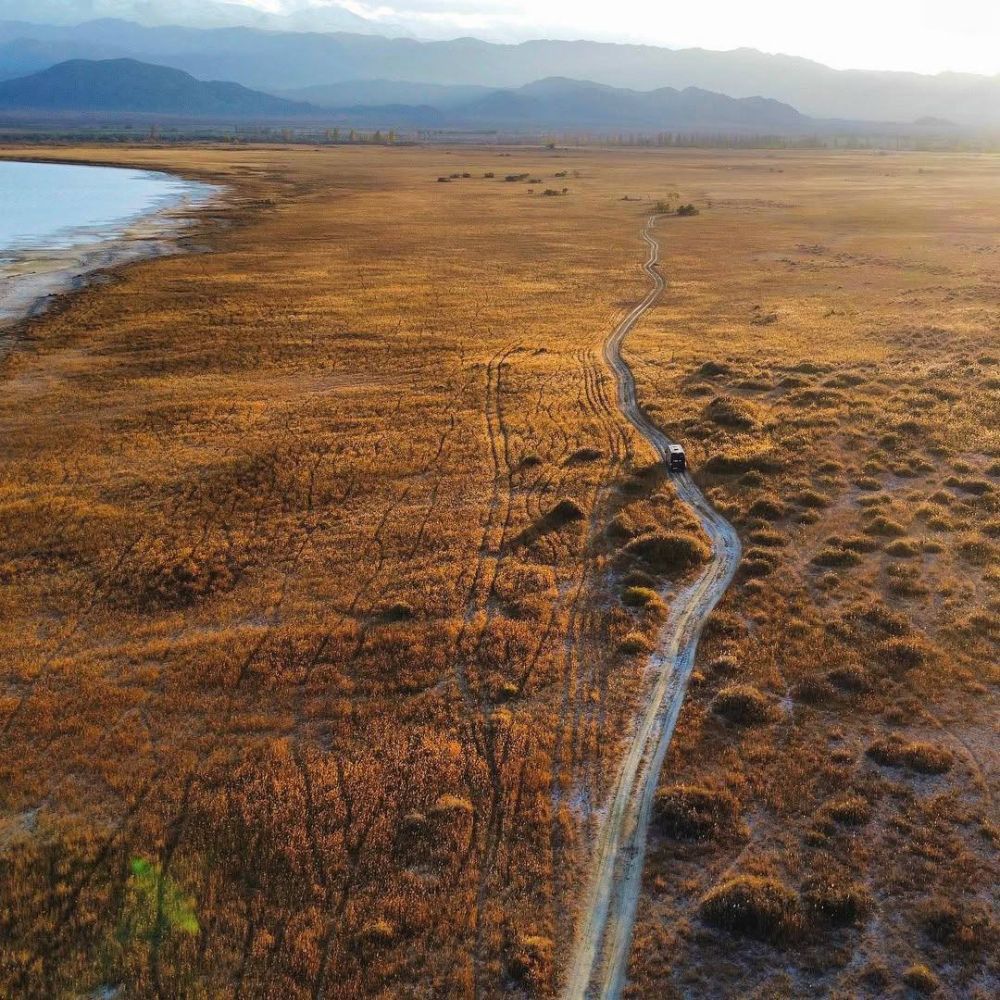
Aksai Canyon differs from most canyons around Issyk-Kul because its greatest beauty is not hidden inside the canyon itself but revealed from above. From panoramic viewpoints, dozens of branching ravines and dry riverbeds create an intricate pattern resembling a nervous system or the blood vessels of a giant living organism.
This is one of the best places to observe the traces of ancient rivers that once flowed toward Issyk-Kul Lake. These channels have remained so clearly visible that local residents gave the area its own name — the Valley of Forgotten Rivers.
Most independent travelers pass by without realizing that just a few kilometers from the main road lies one of the most unusual landscapes on the southern shore of Issyk-Kul. Many guides and experienced travelers consider Aksai Canyon one of the most impressive canyons in the region because of its vast panoramas, peaceful atmosphere, and unique views of Issyk-Kul Lake.
History and Formation
Today, Aksai Canyon appears as a complex labyrinth of ravines and dry river channels. However, thousands of years ago, this area was significantly wetter.
Numerous seasonal streams descended from the Terskey Ala-Too Mountains and gradually carved through the soft sedimentary rocks of the Issyk-Kul shoreline.
Each major flood deepened existing channels and created new branches. Over time, the regional climate became drier, many waterways disappeared, and a vast network of dry valleys remained.
These ancient rivers shaped the canyon's distinctive appearance. Once visitors reach the panoramic viewpoints, it becomes easy to understand why local residents call this place the Valley of Forgotten Rivers. The entire landscape preserves the visible traces of water that disappeared long ago.
Flora and Fauna
Aksai Canyon is located within the dry steppe zone of southern Issyk-Kul.
The landscape is dominated by wormwood, feather grass, caragana shrubs, and other drought-resistant plants adapted to hot summers and limited rainfall.
During spring, the area transforms dramatically. Seasonal wildflowers and ephemeral plants bloom shortly after snowmelt and spring rains. The steppe becomes vibrant green before gradually turning golden-brown by midsummer.
Visitors may encounter larks, partridges, and various birds of prey soaring above the canyon on rising air currents. Due to its remote location, the area retains the atmosphere of an almost untouched natural steppe ecosystem.
Where Is Aksai Canyon Located?
Aksai Canyon is located in the Ton District of the Issyk-Kul Region, near the village of Aksai on the southern shore of Issyk-Kul Lake.
The distance from Bishkek is approximately 300 kilometers.
Traveling along the southern shore highway, visitors should turn toward Issyk-Kul near the village of Aksai. After leaving the main road, the canyon can be reached via a dirt road in approximately 15–20 minutes.
Because there are few signs and navigation points, many travelers struggle to locate the canyon independently. For first-time visitors, traveling with a local guide is recommended. Guides can lead visitors to the best viewpoints and panoramic observation areas.
How to Get to Aksai Canyon from Bishkek
By Car
Drive from Bishkek along the southern shore of Issyk-Kul Lake toward the village of Aksai. After reaching the village, turn toward the lake and continue along a dirt road leading to the canyon.
The journey typically takes around 4 hours.
By Public Transport
Visitors can take a marshrutka (shared minibus) from Bishkek to Bokonbaevo. From there, a local taxi or private transfer is required to reach the canyon.
As Part of a Tour
The most convenient option is a guided South Issyk-Kul tour. Aksai Canyon is often combined with visits to Barskoon Gorge, Jeti-Oguz Gorge, Fairy Tale Canyon, and other attractions along the southern shoreline.
Things to Do in Aksai Canyon
The main sightseeing route through the canyon typically takes between 40 and 90 minutes, depending on the chosen path.
Photography enthusiasts should visit the panoramic viewpoints located on the upper terraces of the canyon. From here, visitors can clearly see the ancient river channels and the entire canyon system.
For a deeper understanding of the landscape, exploring the area with a local guide is highly recommended. Guides often reveal hidden viewpoints and share the fascinating story behind the Valley of Forgotten Rivers.
The route does not require special hiking experience, although some sections include steep climbs and loose slopes.
Best Time to Visit
Spring
Spring is considered the best season to visit. Wildflowers bloom across the steppe, and temperatures are ideal for hiking and sightseeing.
Summer
Summer is excellent for landscape photography. Daytime temperatures can be very high, so visiting between 5:00 PM and 7:00 PM is recommended.
Autumn
Autumn offers ideal conditions for photography thanks to soft natural light, clear skies, and comfortable temperatures. Checking weather forecasts before visiting is advisable.
Winter
The canyon takes on unique colors and textures during winter. However, some access roads may become difficult to navigate after heavy snowfall.
Useful Tips
- Bring at least 1 liter of water per person.
- Wear trekking shoes with good grip.
- Visit early in the morning or late in the afternoon during summer.
- Avoid standing close to unstable canyon edges.
- Climb to the upper terraces for the best panoramic views.
- Mobile phone coverage can be unreliable in deeper sections of the canyon.
- Check road conditions before visiting after rainfall.
Frequently Asked Questions
How long does a visit to Aksai Canyon take?
Most visitors spend between 40 and 90 minutes exploring the canyon.
Can I visit with children?
Yes. Most routes are suitable for families when basic safety precautions are followed.
Do I need a guide?
A guide is recommended. Local guides know the best viewpoints, hidden routes, and can improve overall safety.
When is the best time to visit?
The most comfortable months are April, May, June, September, and October.
Why is it called the Valley of Forgotten Rivers?
The canyon contains remarkably preserved traces of ancient dried-up river systems that are clearly visible from the panoramic viewpoints.
Tours
Aksai Canyon is an excellent addition to any South Issyk-Kul itinerary. Visits to the Valley of Forgotten Rivers are often combined with Fairy Tale Canyon, Jeti-Oguz Gorge, Barskoon Gorge, and traditional eagle hunting demonstrations in Bokonbaevo.
The canyon offers travelers an opportunity to discover a lesser-known side of Issyk-Kul, far from the region’s most crowded tourist attractions. Its unique geological formations, ancient river channels, and spectacular panoramic views make it one of the hidden gems of Kyrgyzstan.